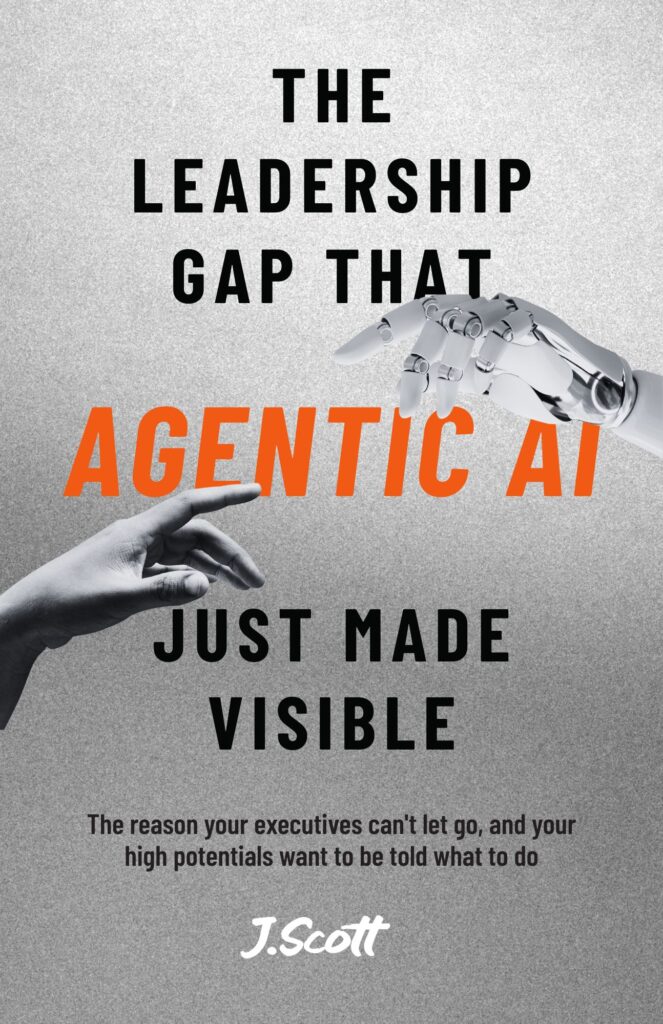

The reason your executives can’t let go, and your high potentials want to be told what to do
You built a strong organization. The talent is there. So why do your executives struggle to hand it off — and why do your best people keep waiting to be told what to do? The answer is the same for both. And it has a name.
THE WORD THAT CHANGES EVERYTHING
Walk into any enterprise leadership meeting right now. Sit in any IT steering committee, any digital transformation review, any C-suite strategy session. One word is on every agenda, every slide, every priority list.
Agentic.
Before you file it as a technology term, understand what it means. Agency is the capacity to make decisions, take initiative, and pursue goals without being told. Agentic describes something that acts with agency rather than reacting to instruction. Reactive waits to be told what to do. Agentic figures out what to do and does it.
This is not a new concept. It is a new label for something humanity has always had access to and consistently failed to develop at scale. Agentic behavior has been available to every human being in every organization in every industry since the beginning of organized work. Now machines can do it too. And the market is investing accordingly.
The tech industry did not invent agentic behavior. It named it. And in naming it, it accidentally named the exact cause of the 67% failure rate between strategy and execution over the last three decades, and the exact capability that will determine which companies thrive and which are left behind in the decade ahead.
TWENTY-FIVE YEARS OF MEASURING THE WRONG THING
For a quarter century, Gallup has published a workforce number that the business world reads as a wellness metric. They call it employee engagement.
They have been measuring something else entirely.
What they measure, what they have always been measuring, is the percentage of people who are actually agentic at work. People who apply their thinking, take initiative, own outcomes, and operate without waiting to be told. Strip away the HR language and engagement describes exactly that. Everything else is presence without agency.
21% of employees globally are engaged. The sharpest decline since COVID lockdowns. (Gallup, 2025)
31% of U.S. employees engaged in 2024 — a 10-year low. Gallup calls it The Great Detachment.
$438B in lost global productivity in a single year. From people who showed up but did not engage their thinking.
36% was the peak, in early 2020. The trend since has been almost entirely downward.
Read the numbers with the correct lens. 21% of employees globally are engaged. 31% in the United States, a ten-year low Gallup itself now calls The Great Detachment. $438 billion in lost productivity in a single year. The peak was 36% in early 2020, and the trend since has been almost entirely downward.
That isn’t a morale problem. It isn’t a benefits problem, a flexibility problem, or a manager-training problem. Every prescription the research firms have attached to this data has failed because every prescription has treated symptoms. The disease is the absence of agentic behavior in the workforce, and the absence of a shared way of thinking and a shared execution system capable of developing it.
That is a precise description of the Strategy Execution Gap, expressed in human terms, measured quarterly, published globally for twenty-five years.
Nobody connected the dots. Until now.
THREE DECADES. FOUR MOVES. THE GAP GETS WIDER.
For thirty years, organizations have watched the distance between what leaders decide and what teams actually deliver consume strategy, capital, and careers.
67% of strategies fail, not because the strategy was wrong, but because no system existed to carry it.
90% of organizations fail to execute strategy effectively (Kaplan and Norton, thirty years of research).
$109 million lost for every $1 billion invested through broken execution systems.
Every C-suite has run the same playbook in response. Four moves, almost always in this order, as the frustration deepens.
Technology: Better tools. The demo was compelling. Implementation ran long, adoption ran thin, and eighteen months later the team was doing the same things inside a more expensive platform. A tool does not fix broken execution. It automates it.
Training: Better skills. Leaders came back from training energized. The vocabulary sharpened. There was a brief window where things felt possible. Then Thursday happened, and by month three the workbooks were on a shelf.
Talent: Better people. The A-player arrived with energy, hit the same priority collisions, the same escalation patterns, the same silence masquerading as alignment. By month six: assimilated or gone. Great talent does not fix a broken execution system. It runs inside one, or it leaves.
Transformation: Burn it down. The departments got new names. The org chart was redrawn. Consultants filed a 90-day diagnostic. Underneath all of it, the same leadership system made the same decisions and produced the same results.
The gap does not close. It gets wider. The Gallup data proves it. And now the tech industry has deployed a fifth solution.
THE DIAGNOSIS NOBODY MADE
Angela Duckworth gave us the formula. She calls it the Grit Scale.
Talent x Effort = Skill. Skill x Effort = Achievement. Effort is the multiplier, and it appears twice.
That isn’t motivational language. It is a clinical diagnosis of why the engagement scores keep falling and why every prior “better” attempt has failed to move them.
Talent is not scarce. The willingness to apply effort twice is almost always there in a new hire. So they apply it twice, through the resistance, through the obstacles, through the discomfort of owning an outcome that might not work. And eventually they disengage or leave.
What is scarce is a shared execution system. A common way decisions get made, returns get defined, and work gets done. Without one, effort has nowhere to land. Grit converts capability into achievement, but only inside a system built to focus what grit produces. So when Gallup counts the engaged, it is not counting who has the grit. It is counting people who landed somewhere their grit pays off.
Disengagement is the result of a different scale. Talent x Effort = Bad Habits. Bad Habits x Effort = Busy Work. That is the Burnout-Busy Scale. The people don’t produce it. The default system does. The same default system that produces the Strategy Execution Gap.
THE MARKET SEES IT
Agentic AI is the tech industry’s investment thesis against that gap. It is a bet that the dysfunction is real, the scale is enormous, and the return on solving it is historic. The investors are right about the problem.
But once again, we are wrong about the solution. Drop agentic AI into the default system and we don’t fix the dysfunction. We automate it. The same results, just faster. The same system that ground down the agentic humans until they disengaged. The Strategy Execution Gap at machine speed: too fast to absorb, too loud to hide.
That’s the leadership gap, finally visible.
Every board is asking, and every customer I work with is being told, to use AI to cut costs and increase productivity. That isn’t leadership. It’s autopilot. An instinct can be corrected; a promise to Wall Street cannot, not without a price. Once you guide investors that AI will lower headcount, the layoffs stop being a strategy and become a deliverable, a public commitment to the two things that were never the problem: output and cost.
And it is a promise the default system cannot keep. The cost cut is real. The value is not. So the company delivers the half that destroys capability (the headcount) and quietly misses the half that mattered.
TWO FUTURES. ONE CHOICE.
The first future is the straight line from where we are. Companies keep the same model and the same thinking, point AI at it, and ask for two things: more productivity and fewer people. They don’t replace the default system. They replace the humans inside it.
Play it forward.
Year one looks like a win. Headcount drops, the cost line improves, and the market rewards the cut, the return the layoffs promised. The initiatives launch to applause.
Year two, the base rate arrives. 95% of corporate generative AI pilots are already failing to deliver measurable business value (MIT NANDA, The GenAI Divide, July 2025). The capability that walked out in year one does not walk back. The productivity that was supposed to replace it never shows. The cost cut was real. The growth was not.
Year three, the bill comes due. The Strategy Execution Gap now runs at machine speed. The people who were cut aren’t producing, and they aren’t buying. Demand contracts. The bottom line that looked healthy on subtraction has nothing underneath it. And the promise every company made to the market unwinds at once, because none of it was ever real.
This isn’t a forecast. It’s a rerun.
In 2000, capital poured into the internet on a productivity revolution. The technology was real. The businesses underneath were hollow, the old model with a website bolted on. When the gap between promise and value became undeniable, roughly $5 trillion in market value evaporated and the economy fell into recession. The glaring example: Barnes & Noble bolted a website onto an old model. Amazon built a model that would thrive in the internet economy. In 2008, automated securitization scaled a broken lending model faster than any human could, until the dysfunction was wired through the entire system. Then it collapsed.
Both times we blamed the technology. Both times the technology was innocent. What crashed was a new tool running a broken execution system at a speed the system was never built to survive. What needed to be questioned was the thinking that led the tech deployment.
AI is faster, cheaper, and reaches deeper into the work than anything before it. Which means the crash it can run is bigger than anything before it.
THE OTHER FUTURE: REPLACE THE SYSTEM
There is another future. It begins when companies stop using AI to automate their current dysfunction and start replacing the system that produced it.
The alternative is not deploying AI better. It is replacing the default with a real execution system, a shared way of working that converts effort into outcomes that compound. We call ours the Execution Leadership System (ELS). The system requires three things, documented in writing: how decisions get made, what counts as a return, and how the work actually gets done. Not a work management or project management tool. A way of operating, durable enough to absorb both the humans and the AI delivering against it.
The guardrail is the Three Pillars: Customer Satisfaction, Team Satisfaction, and Profitability. None at the expense of the others. Every initiative, human or AI, earns its place only when it measurably improves all three. That is how you eliminate the trade-offs the default system has been forcing on you for thirty years.
Inside that system, work distributes across three layers.
Layer one is the repeatable. AI runs the assembly line. Document review, scheduling, drafting, summarization, code generation. Anything where the pattern is stable and the judgment shallow. This is the only layer where the headcount story is real, and even there, real only when freed capability is redeployed against work that compounds.
Layer two is the problems with no pattern match. The customer call that doesn’t fit a script. The cross-functional dispute where every option trades off against another. The strategic move that requires reading silence in a room. This is where agentic humans run, the ones whose grit lands because the system rewards what they produce.
Layer three is leading the thinking. You cannot automate good judgment. You cannot automate the creation of a new idea, the assembly of a prototype, the decision to choose against the consensus because the consensus is wrong. The moment leadership becomes automated, it stops being leadership. The agentic leader sits above both layers, allocating time, attention, and capital, not authorizing work, but challenging it, against measurable returns.
The math inverts. In the default system, Talent x Effort = Bad Habits, and Bad Habits x Effort = Busy Work. In a real execution system, the same equation runs clean. Same people. Same effort. Different system. Different result.
We have applied the ELS inside Fortune 1000 leadership teams (AT&T, Sony Pictures, Sysco, ResMed, Blizzard Entertainment, Trader Joe’s, and others) for twenty-five years. The success rate is 98%, against an industry baseline of roughly 30%. The number is not proof that any system is magic. It is proof that the Strategy Execution Gap is a systems problem with a systems solution, and that the solution does not require new people, new strategy, or new technology. It requires installing a way of working durable enough to convert the effort already in the room.
COZY OR CLIMB
This is the future where the economy is thriving, essential goods are inexpensive, and burnout-busy is no longer a badge of honor. The people who performed the repeatable jobs that AI replaced are not abandoned. The same productivity that makes companies more profitable funds the safety net that catches them, an elevated social security, funded by the dividends of the automated economy. Musk, Altman, and Gates have all named some version of this destination. The economics are self-funding: when 80% of a factory’s labor cost is replaced by machines, the profit that gets taxed expands dramatically.
Universal Basic Income (UBI) is not upper middle class. It is not the house, the experiences, or the identity that comes from building something that matters. It is a modest life with a ceiling. Cozy. Simple. Nobody falls through, and nobody is told they can’t earn more.
For those who want more, the path is wide open. That work requires leading thinking. It requires agentic humans who can run above the machines, not alongside them. And it pays extraordinarily well, because the supply of genuinely agentic leaders has always been scarce, and the demand is about to compound.
Cozy or climb. Both are dignified. Both are funded. Both are real. One requires the leading of thinking, not the deployment of AI on autopilot. Not the way we always do it.
TWO PEOPLE. SAME JOB TITLE.
One is being replaced. One is irreplaceable.
The replaceable tracks tasks. Follows the process. Waits for direction.
The irreplaceable leads thinking. Owns outcomes. Removes obstacles.
Same job title. Different futures. The system you install decides which one your team becomes.
THE WAKE UP CALL
The choice is not being made when the automation arrives. It is being made right now. In every budget meeting where an executive asks for more productivity and fewer heads. In every directive to IT to “implement AI.” In every promise to the market that the cost cut is coming. In every leadership team that thinks deploying a tool will improve their results.
It won’t.
Deploy a tool, get a tool. Deploy a mindset and a shared way of working, get an outcome.
The world is not short on talent. It has never been short on willingness. It is short on the system that converts both into outcomes that compound.
That is the only gap that matters now.
AI made the leadership gap visible. Closing it is a leadership decision.
SHIFT QUESTIONS
Shift 1
Name one high-potential person on your team in the last six months whose energy you have watched dim. Not someone who quit. Someone who is still there, still showing up, someone that has become burnout-busy trying to keep up and is starting to echo the excuses you hear from the rest of the team. Now run through your entire team? What percentage of your team is on that list?
Shift 2
What did you say about AI in your last earnings call, board meeting, or all-hands? The specific words. The specific productivity gain or headcount reduction you committed to. Now look at the pilots running inside your organization today. What is the gap between the number you committed to and the number your pilots are actually on track to deliver, this quarter?
Shift 3
The US military is the most effective defense force in the world. Compare their cognitive ability against corporate America and it fails badly. But look at their results. They operate a shared mindset and a shared execution system. It is documented. It is trained as a team. They don’t have a strategy execution gap.
Can you pull out your documented execution system?
If you asked your VPs what criteria they use for approving work, what they use for measuring a return on investment, and how their teams translate strategy to execution, would any of them give you the same answer? Would you get a clear answer?
The Execution Leadership System is the antidote to the Strategy Execution Gap. Built across twenty-five years of Fortune 1000 transformations. Installed by 120VC. Install the system before you deploy the tool.
Talk to us about installing the ELS in your organization →